Workers’ Comp Fraud in California and the Underground Staffing Economy
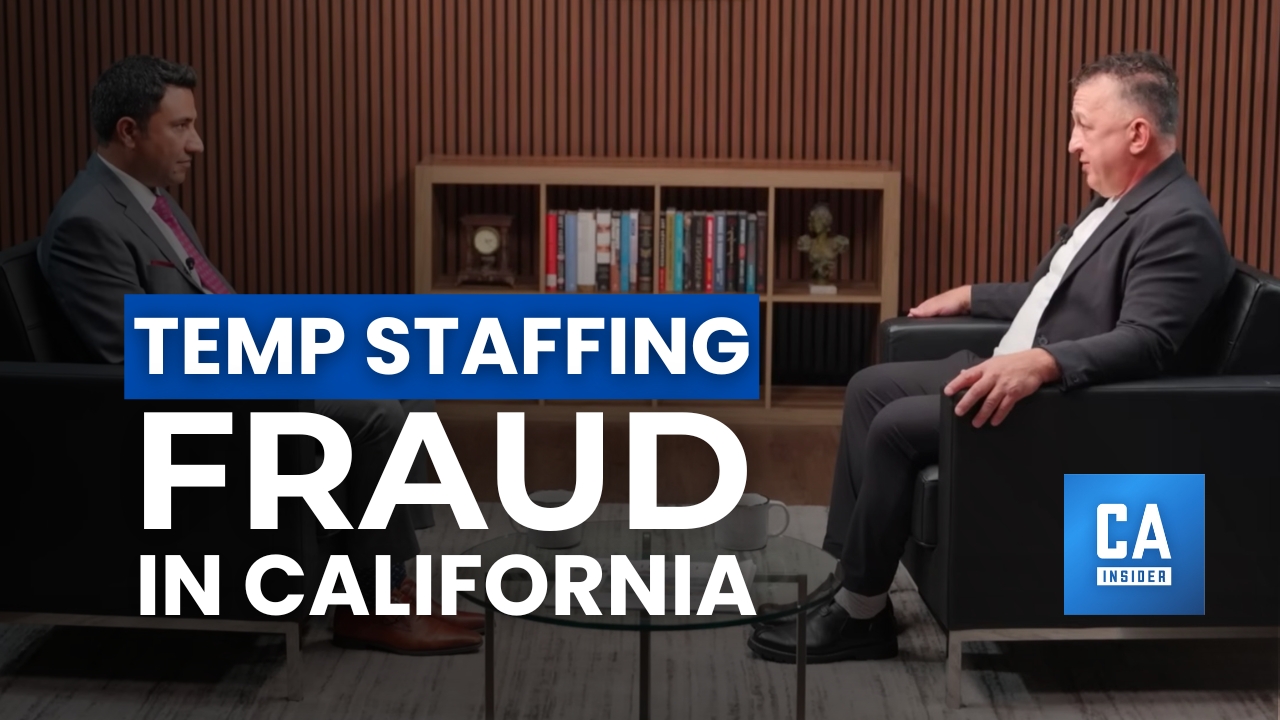
In this interview from California Insider, host Siamak Khorrami speaks with Mike DiManno, CEO of Employ Insure, about how workers’ compensation fraud has spread through California’s staffing industry, why bad actors are gaining market share, and why the financial incentives for fraud have become so dangerous.
Interview Transcript
Siamak Khorrami (Host):
Now we go to Mike DiManno, who's actually a player in the staffing industry, to see what he's seeing and how the industry is doing.
The Underground Market in Staffing and Workers’ Comp
Mike DiManno:
I think one thing to recognize is the contingent labor force in this country is getting very large, and it's supported by demographics that are going to make it continue to get bigger and bigger and bigger.
Workers’ comp, particularly in staffing, is very difficult.
And so, there's been an underground market that has existed for workers’ comp and staffing since as long as I've been here — 30 years.
It's held in check by a couple of things.
Number one, customers are unwilling to accept certificates of insurance from the staffing agency because they know that if the certificates aren't legit, then they'll be responsible for the claims.
So that's always kept the little shady gray-area staffing agency with no insurance — or maybe borrowing someone else's insurance — in check.
How the Market Shifted
Mike DiManno:
What's happened is over time the demand for labor is so great that businesses try one of these — I'll call them left-handed certificates.
They try them to get a few more employees where they can't get them, and the regulators don't do anything.
So the rates that these illegal agencies charge are significantly less because they're not paying for workers’ comp.
In that case, the workers’ comp cost is the second biggest cost next to the wages itself.
So it's a significant number.
These agencies who were shunned before now all of a sudden are welcomed by customers with open arms because they're looked at like, “I can't get the employees I need. Maybe these guys can do it.”
So they try it.
The state doesn't slap them on the hand.
And so now, especially after COVID, there's complete disregard to check and make sure that a staffing agency has workers’ comp.
And so if you can come in and undercut the legitimate players, the market share goes to you.
Right now, all of the honest staffing owners can't compete. They start leaving the business, and they're replaced by criminals.
“More Profitable Than Robbing a Bank”
Mike DiManno:
Workers’ comp fraud — recently there was a state of the state address by the WCIRB.
They monitor all the records for the state, and once a year they put on a session to talk about trends and what's going on.
At the end of the meeting, they were doing Q&A, and someone said, “What do you think about all the fraud going on in the workers’ comp market today?”
And her statement was something along the lines of:
“It is now significantly more profitable and less risky to engage in workers’ comp fraud than it is to rob a bank.”
So we're inviting these criminals who understand that into a system.
They use the workers’ comp and the staffing to generate a tremendous amount of cash flow.
Once they're getting that cash flow, 90% of it belongs to the employees for wages, the government for taxes, and the insurance company to insure them.
So if you have a thousand temp employees, that's about 40 million in payroll and about 55 million in total billings.
Most of that money — 51 million out of the 55 — is held in trust so the workers can get their wages, the government can get their taxes, and so on.
But when you put a criminal in charge of that with no governance, they start stealing tax money and they start stealing wage money from workers who don't have attorneys to defend themselves, and they don't have the knowledge to really understand what's being done to them.
The Scale of the Fraud
Siamak Khorrami:
So you're in this space, you're seeing all of this. How big is it?
Mike DiManno:
To give you a scale of the whole thing, it's in the many, many billions.
So we're losing tax dollars, employees are losing benefits, and so on, in the billions.
There's a single entity that everybody knows — they've been to court and lost, and the judges said this is a fraudulent transaction and even posted in the paper that people were not allowed to do business with these entities.
Everybody knows it, but they're still in business.
We had gotten their request for insurance — it's one of the things our company does — and I saw how big it was.
There was $4 billion of payroll with one company being done with no workers’ comp.
How the Fake Certificate Scheme Works
Siamak Khorrami:
Four billion of payroll with one company without workers’ comp?
Mike DiManno:
Yes.
What they do, very similar to me, is they tell staffing agencies, “I can give you workers’ comp.”
What they do is they give them a piece of paper that's not valid.
It's doctored up, and it's made to look like it's valid insurance, but it's not.
What they'll do is they'll buy a little landscaping company with, let's say, 12 employees on it, and they'll go get the policy under that landscaping company.
So if you call the number on the paper and it's Zurich and you say, “Is this number valid?” they'll say absolutely.
But they will back up a billion dollars of payroll onto that certificate, and they use that number to show clients, “Look, we have a valid cert.”
It's literally a multi-level marketing setup.
There could be four different layers of entities using this one cert.
The insurance company has absolutely no idea any of this is being done.
What Happens When Someone Gets Hurt
Mike DiManno:
So when an injured employee comes in, they pay the claim under the table and they don't cover the long-term exposure of the claim.
In other words, if you twist your ankle, I've been keeping all the money instead of giving it to the insurance company, so I may pay for you to go get your ankle fixed.
But if you break your back, I just shut the company down and start up another company — even at the same address — and say, “That company went out of business.”
And the state of California will pick up a $400,000 or $500,000 claim because when the liability gets too big, these companies just say, “Yeah, we're out.”
The Public Safety Net Gets Stuck With the Bill
Siamak Khorrami:
And the state has to pay for that, right?
Mike DiManno:
Yeah.
We have two funds.
One is the uninsured fund. It's designed to be a catcher’s net for an employee who maybe got hired by someone who didn't have insurance or somehow fell through the cracks.
The state's like, “Okay, we'll make sure that employee is taken care of.”
The other one is called a subsequent benefit fund.
That's when whatever settlement they reached isn't enough and that employee may have additional exposure or needs.
We have a fund to say, “Well, the system didn't really cover them well enough, so we're going to provide additional coverage.”
But those two funds, the frauds look at as their backup.
They go, “We'll build it up and shut it down.”
Then they go back to their network of staffing agencies, brokers, and customers using the fraud and say, “We got a new one.”
Why the Fraud Grew So Fast
Mike DiManno:
If you talk to some staffing agencies, they'll say, “I can't get insurance in California.”
Not a lot of insurance carriers are willing to write staffing agencies in California because of the fraud.
That's part of what caused it to grow so large.
Another thing that used to keep staffing agencies in check was that they couldn't get funding.
They couldn't get factoring to pay employees and float invoices until the customer paid.
So you'd sell your invoices to the bank.
Traditionally, the banks would never finance these illegal operations.
Then COVID happened.
Legit and non-legit staffing agencies got PPP money and paid off their bank lines.
Now the factoring companies and banks had a lot of money they needed to put back into the market.
They started realizing, “Nobody's really prosecuting the frauds. Maybe we should look at them as an opportunity.”
Once the factoring companies accepted illegal certificates — even though it's their job to check that coverage is legitimate — it exploded.
Everybody and their brother said, “If I can get financing, clients love it because the rates are low, and I’ve got some guys who say they handle the claims, so why not?”
The Gateway Into a Criminal Labor Economy
Mike DiManno:
No prosecution anywhere in the food chain.
And if there is a prosecution, it's so small it's like seeing a guy on the side of the road who got caught speeding.
This workers’ comp practice is kind of like the gateway in.
Now the criminals have entered this trust business called staffing where I can undercut somebody and get all of the cash flow — the wages, the taxes — and tell the client, “We're taking care of everything, it's my liability,” and then I just steal.
Proposed Solutions and Legislative Efforts
Siamak Khorrami:
You're in this space and there are some laws people are working on. Is there a fix to this?
Mike DiManno:
There are so many people now benefiting, and all of their businesses are entrenched in the economics of the fraud market.
The banks are benefiting, the lenders are benefiting.
A bank or factoring company can make three or four times as much financing a fraud.
They're basically saying, “I'm willing to accept your fraudulent certificate, but you're going to pay me 50% interest.”
So now the banks are making more than the frauds.
It is very complex.
It happened over time.
Everybody is kind of culpable, but no one is totally culpable.
That's this underground market that turned into this moral hazard — where people act like nothing's wrong.
Workers’ comp exists for really good reasons.
It protects business owners and employees and it's supposed to do so efficiently.
When that falls apart, everything dependent on it falls apart too.
The state is already losing billions of dollars of tax money.
But the problem is so big and crosses so many departments that it's difficult for one entity, one business, or one part of the state to say, “I'm going to take care of this.”
So they all point the finger at each other.
What Should Be Done Next
Siamak Khorrami:
What should they do tomorrow if you were in charge? What would you do to fix this?
Mike DiManno:
The number one thing you have to do is eliminate the moral hazard.
The banks, the customers, the brokers — all the people making money on the periphery — have to understand it's not okay anymore.
There's a new bill being proposed that would suggest licensing.
It's not a complex bill. It doesn't have all the things we could put in it.
But licensing would at least say: we want to make sure you're not a bank robber or a federal felon because we can't put you in charge of that kind of money.
Second, do you have experience in the industry?
This is a really hard business to do.
And do some basic background checks so we can eliminate the people who are being creative in the fraud.
The owners who shouldn't be in this business would not be able to get a license.
The license would basically say, “Tell us your experience because this is not an easy industry. And if you have a staffing agency, show us your workers’ comp certificates.”
If you don’t have them, you don’t qualify.
Then the people doing it right will see the value of their business go up.
The markups will return to where the bills can actually be paid.
That would have a massive impact.
The other thing is people need to understand they are participating in an underground labor scenario that has detrimental effects not just to the workers, but to the insurance community because we end up paying for all of their fraud.
The economics of many businesses now run on assumptions of costs that can't actually pay for taxes and workers’ comp.
That’s a very stubborn metric to move.
There’s a whole network of brokers — some licensed, some not — that market these products.
And when a new one pops up,
it just like a like a electricity. It just goes through the system and a billion dollars of illegal businesses popped up overnight.
Why This Matters
The practices described in this interview highlight a growing vulnerability in California’s temporary staffing system. When workers’ compensation coverage is misrepresented or bypassed, injured workers can be left without proper protection while legitimate staffing agencies and employers who follow the law struggle to compete against operators cutting corners.
The impact extends beyond individual workplaces. Lost payroll taxes reduce public revenue, insurance systems become strained, and state safety-net programs often absorb the cost when uninsured claims arise. As the scale of the issue grows, stronger oversight and verification measures become critical to protect workers, responsible businesses, and the integrity of the system itself.
This article contains verbatim transcript excerpts from the interview “Bad Actors Are Infiltrating California's Staffing Industry | What's Happening?” featured on California Insider, hosted by Siamak Khorrami.
Original reporting and video produced by California Insider:
https://californiainsider.com/california-news/videos/california-insider-show/californias-staffing-industry-has-a-fraud-problem-whats-happening-5997580
Watch Mike DiManno's interview here: