Why Prosecutors Say California Needs Oversight of Staffing Agencies
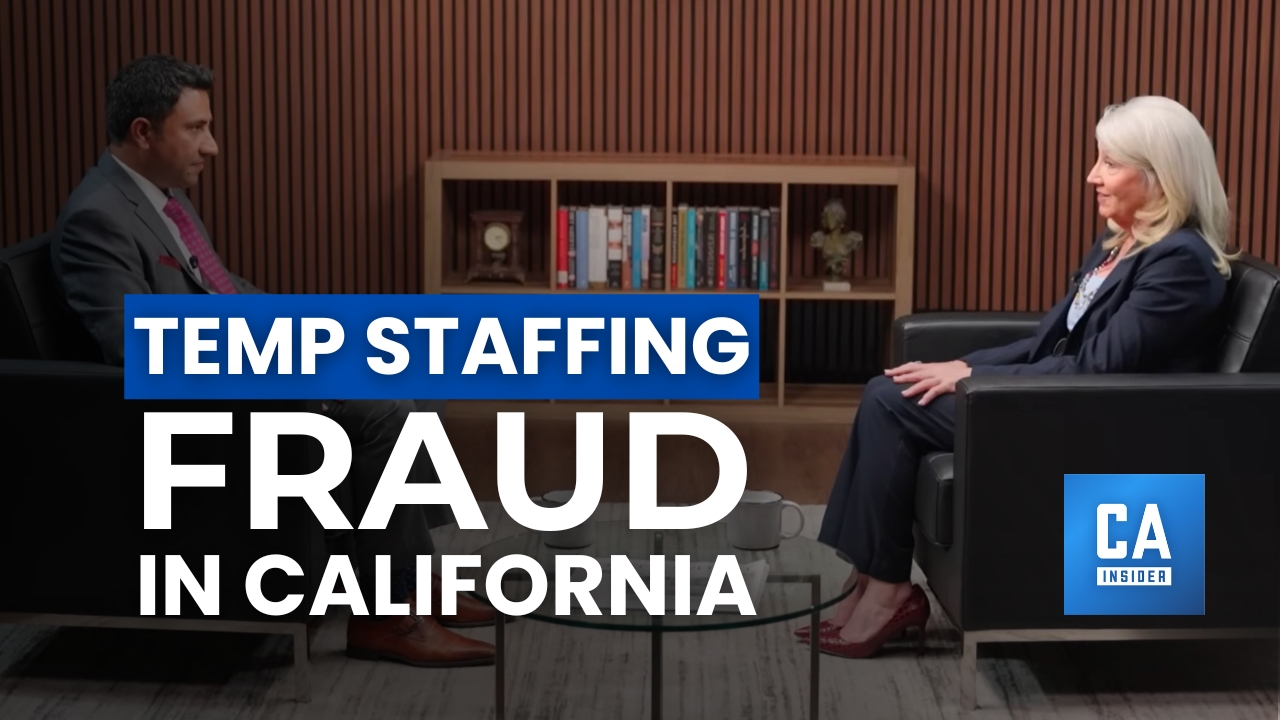
Temporary staffing now represents a significant portion of California’s workforce. Former Los Angeles County prosecutor Jennifer Lentz Snyder says the lack of registration requirements for staffing agencies has made enforcement difficult.
Interview Transcript:
The Scale of Staffing in California
Jennifer Lentz Snyder:
I think it's first of all important to put staffing in context in California because it's not something that some people think about very often.
When I think of staffing, before I found out what the problem really was, I thought of Kelly Girl or Apple One or temporary agencies that might place workers in clerical and so forth.
The truth of the matter is, according to the American Staffing Association, there are more than 1.9 million employees in California that work through staffing. That was as of 2023.
Here's what's striking about that.
In California, according to the Department of Industrial Relations, the non-farm workforce is 19 million.
That means that almost 10% of the non-farm workforce in California is involved in staffing.
Staffing covers a variety of different industries. It's not limited to clerical or office work. It can be in virtually any setting.
And the fact that there's 10% of that workforce involved in an industry that is not even licensed in California is staggering.
How the Staffing Model Works
Jennifer Lentz Snyder:
Here's the problem.
When you work for a staffing company, the workers are assigned to a location and they work for another existing company.
Smaller companies bring in staffing when they have absences or when they are growing at a pace that prevents them from onboarding enough people.
So they rely on staffing companies to fill those needs.
The staffing company hires the employees and assigns them to client employers.
The staffing company is responsible for those employees. They are the employer.
That means they are responsible for workers’ comp insurance, payroll taxes, and all related obligations.
“Too Good to Be True” Pricing
Jennifer Lentz Snyder:
When staffing companies go to businesses in need, the business looks at the cost.
The problem arises when staffing companies offer deals that are too good to be true.
They offer staffing at rates that do not allow them to pay into payroll tax funds or cover workers’ comp premiums like legitimate businesses do.
Workers enter these jobs thinking they are properly employed.
Then they get injured and find out the staffing company wasn't insured, or was underinsured.
They may also discover that payroll taxes were not properly paid into the systems designed to protect them.
When Workers Are Left Unprotected
Jennifer Lentz Snyder:
When that happens, workers’ cases go through the Workers’ Compensation Appeals Board.
If the employer is uninsured, the case goes to the uninsured employer benefit trust fund.
That fund exists to cover situations where workers are left without coverage because their employer failed to carry insurance.
It sounds like a simple solution, but it's not.
The Scale of Fraud
Jennifer Lentz Snyder:
Workers’ comp fraud in California is valued between $1 and $3 billion a year, according to the National Insurance Crime Bureau.
If even 10% of that is attributable to the staffing sector, that’s $100 million to $300 million annually.
This has gone under the radar as part of what is now called the shadow economy.
The “Shadow Economy”
Jennifer Lentz Snyder:
The shadow economy is an environment where workers are assigned to various workplaces, but the real employer operates in the shadows.
They may have multiple identities, operate out of state, and lack transparency and accountability.
These staffing agencies hide who they are, avoid paying their fair share, and compete unfairly with legitimate companies.
Impact on Legitimate Businesses
Jennifer Lentz Snyder:
There are legitimate staffing agencies that follow the law. They pay taxes and carry workers’ comp.
But there is another category that does not.
They don’t pay taxes, they don’t pay for workers’ comp, and they undercut pricing.
They are competing unfairly, taking advantage of workers, and profiting at the expense of legitimate businesses.
In a state like California, where we want a strong economy, allowing this to continue is harmful.
Why Costs Keep Rising
Jennifer Lentz Snyder:
Workers’ comp and payroll tax systems exist to support workers during disability, illness, or unemployment.
But those funds are not paid into by the cheating entities.
As a result, legitimate businesses end up paying more than their fair share.
Their workers’ comp costs are skyrocketing.
Why?
Because the legitimate companies always end up paying for the cheaters.
The SAFE Act Proposal
Jennifer Lentz Snyder:
The staffing industry has come together to support legislation called the SAFE Act — Staffing Agency Fair Employment.
It would create a registration requirement for staffing companies in California.
Companies would need to:
Identify who owns and controls the business
Disclose where they operate
Prove financial responsibility
Show proof of legitimate workers’ comp insurance
This is about creating transparency and accountability.
Why Enforcement Is Difficult
Siamak Khorrami:
Why isn’t this being tackled more aggressively?
Jennifer Lentz Snyder:
It is a loophole, and that’s why legislation is so important.
There is currently no requirement for staffing companies to be registered.
Investigating fraud requires enormous resources.
Fraud is built on deception.
Imagine a knot of yarn with different strands going in every direction — that’s how these schemes are structured.
They create chaos to avoid detection because they know investigations take time and resources.
Even if they are caught, the money is often already gone.
Why This Is Different from Other Fraud
Jennifer Lentz Snyder:
This is similar to many fraud schemes, but the key difference is the impact on workers.
Workers are placed at greater risk.
It also harms small and growing businesses by creating an unfair competitive environment.
Instead of rewarding legitimate companies, we are burdening them.
Will Licensing Solve the Problem?
Siamak Khorrami:
Do you think registration and licensing will solve this?
Jennifer Lentz Snyder:
I don’t know that it will solve the problem entirely, but it is an essential first step.
We need to know:
Who is responsible for the workers
Who is financially benefiting
Who is making the decisions
And we must ensure they are insured like every other employer in California.
Creating transparency allows us to hold the right people accountable.
Every employer in California must carry workers’ comp insurance or be self-insured.
Staffing agencies should be no different.
Closing
Siamak Khorrami:
Jennifer Lentz Snyder, former prosecutor, it was great to have you on California Insider.
Jennifer Lentz Snyder:
It's been my pleasure. Thank you so much.
Why This Matters
Jennifer Lentz Snyder’s insights reveal a critical gap in California’s staffing system, where nearly 10% of the workforce is involved in an industry lacking basic oversight. When non-compliant staffing companies avoid paying workers’ comp and payroll taxes, workers are left unprotected, legitimate businesses are forced to absorb higher costs, and public safety-net programs carry the financial burden. Without transparency, registration, and accountability, the system continues to reward bad actors while disadvantaging those who follow the law—making meaningful reform increasingly urgent.
This article contains verbatim transcript excerpts from the interview “Bad Actors Are Infiltrating California's Staffing Industry | What's Happening?” featured on California Insider, hosted by Siamak Khorrami.
Original reporting and video produced byCalifornia Insider:
https://californiainsider.com/california-news/videos/california-insider-show/californias-staffing-industry-has-a-fraud-problem-whats-happening-5997580
Watch the Jennifer Lentz Snyder interview here: